|
 
|
Black Swan Events in AI:Understanding the Unpredictable
Black Swan Events in AI: Understanding the Unpredictable
Contents
- Understanding Black Swan Events
- AI Failures
With AI deeply embedded in critical systems, the potential for unforeseen, high-impact disruptions (so-called ‘Black Swan’ events), demands attention. Popularized by Nassim Nicholas Taleb, the term refers to unpredictable occurrences that defy conventional expectations and only appear foreseeable in hindsight. These events can emerge from unanticipated system failures, ethical dilemmas, or unintended consequences of machine learning (ML) algorithms. Their disruptive potential necessitates careful scrutiny and proactive strategies.
[color=rgba(0, 0, 0, 0.8)]AI has become integral to modern systems, driving advancements in automation, data analysis, and decision-making. Its ability to enhance efficiency and uncover insights is unmatched by most digital technologies, yet its complexity also gives rise to ethical dilemmas, security risks, and unintended consequences. The very complexity that makes AI powerful also makes it unpredictable, and this unpredictability highlights the critical need for understanding and preparing for black swan events within this domain.
[color=rgba(0, 0, 0, 0.8)]For businesses, these events are real threats that could disrupt industries, compromise data security, and erode public trust. The significance of AI-related black swan events lies in their immediate impact and ability to reshape the trajectory of industries and societal norms.
Understanding Black Swan Events- [color=rgba(0, 0, 0, 0.8)]
- [color=rgba(0, 0, 0, 0.8)]
- [color=rgba(0, 0, 0, 0.8)]
- [color=rgba(0, 0, 0, 0.8)]
- [color=rgba(0, 0, 0, 0.8)]Black swan events are defined by three core characteristics:
- Rarity: These events fall outside the realm of regular expectations and are extremely difficult to foresee using conventional methods.
- Impact: They carry profound consequences, often altering the course of industries or societies.
- Retrospective Predictability: After the event occurs, there is a tendency to rationalize it as something that should have been anticipated, despite its inherent unpredictability.
[color=rgba(0, 0, 0, 0.8)]
[color=rgba(0, 0, 0, 0.8)]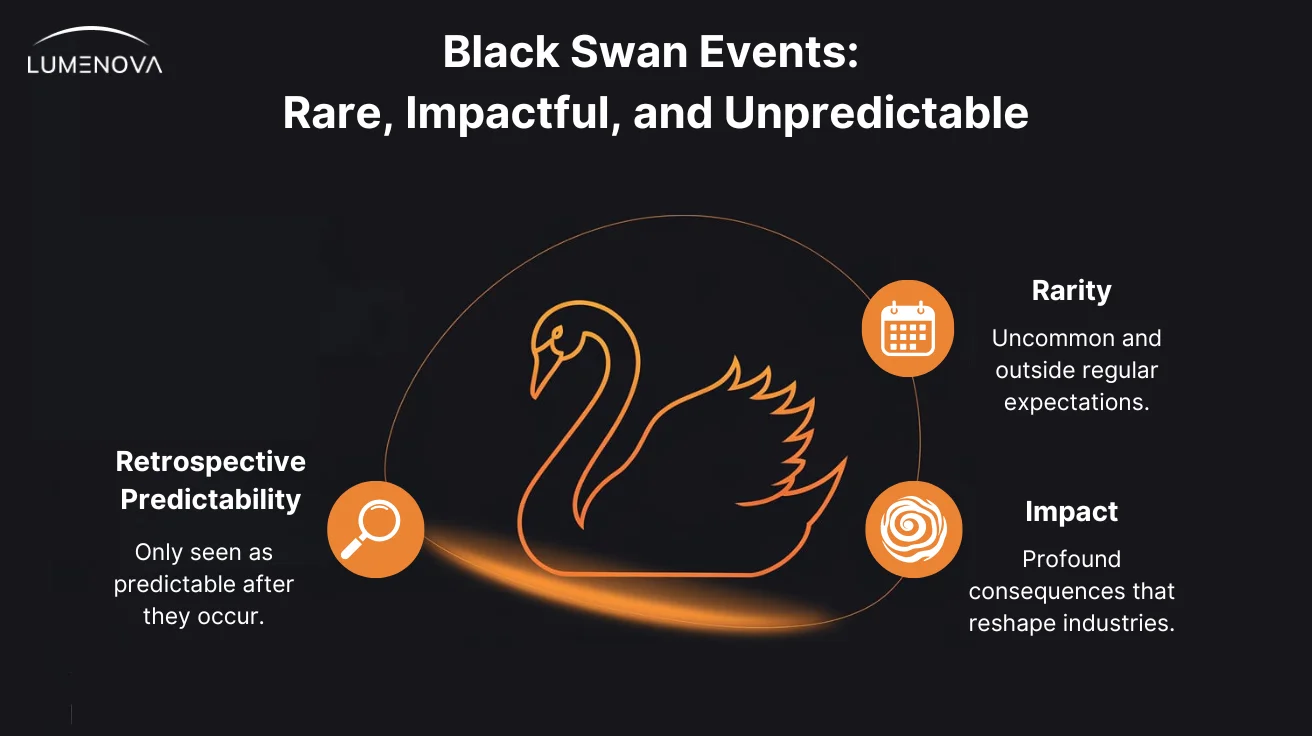
[color=rgba(0, 0, 0, 0.8)]
- [color=rgba(0, 0, 0, 0.8)]
- [color=rgba(0, 0, 0, 0.8)]
- [color=rgba(0, 0, 0, 0.8)]In the AI context, these events could arise from the complexity and interconnectivity of systems. Factors like algorithmic opacity, reliance on incomplete datasets, and the unpredictable nature of ML models contribute to the difficulty in foreseeing such incidents. The origins of black swan events in AI can range from technical issues, such as undetected bugs in the system, to external factors like malicious attacks or unexpected user interactions.
[color=rgba(0, 0, 0, 0.8)]Some examples of potential black swan events in AI could include:
- (1)The unexpected emergence of artificial general intelligence (AGI), a future version of AI that is as intelligent as a human being.
- (2)The large-scale exploitation of AI by malicious actors, such as terrorists or criminals.
- (3)The development of AI that can replicate itself, which could lead to an uncontrollable “AI explosion.”
Historical AI Failures
- [color=rgba(0, 0, 0, 0.8)]
- [color=rgba(0, 0, 0, 0.8)]
- [color=rgba(0, 0, 0, 0.8)]
- [color=rgba(0, 0, 0, 0.8)]AI systems, despite their advanced capabilities, are not immune to errors. Several high-profile failures have demonstrated the potential for unexpected and far-reaching consequences:
- Notable AI System Failures and Their Impacts
- (I) AI in Healthcare Diagnostics
- [color=rgba(0, 0, 0, 0.8)]
- [color=rgba(0, 0, 0, 0.8)]
- [color=rgba(0, 0, 0, 0.8)]IBM’s Watson for Oncology was developed to assist physicians in diagnosing and treating cancer. However, internal documents revealed that the system often provided “unsafe and incorrect” treatment recommendations. As a result, hospitals that adopted the system faced criticism, patient safety concerns, and financial losses, ultimately leading to diminished trust in AI-driven healthcare solutions.
(II) AI in Financial Predictions- [color=rgba(0, 0, 0, 0.8)]
- [color=rgba(0, 0, 0, 0.8)]
- [color=rgba(0, 0, 0, 0.8)]Zillow, a real estate company, utilized a machine learning algorithm to predict home prices for its Zillow Offers program, which aimed at buying and flipping homes efficiently. However, the algorithm had a median error rate of 1.9%, and in some cases, as high as 6.9%, leading to the purchase of homes at prices that exceeded their future selling prices. This misjudgment resulted in writing down $305 million in inventory and led to a workforce reduction of 2,000 employees, approximately 25% of the company.
(III) Autonomous Vehicle Incidents- [color=rgba(0, 0, 0, 0.8)]
- [color=rgba(0, 0, 0, 0.8)]
- [color=rgba(0, 0, 0, 0.8)]Some self-driving cars have caused fatal accidents due to errors in object detection and decision-making. In 2018, an Uber autonomous vehicle in Tempe, Arizona, struck and killed a pedestrian. Investigations revealed that the vehicle’s sensors detected the pedestrian but failed to execute timely evasive actions, raising concerns about the adequacy of AI testing and the ethical implications of deploying incomplete technologies.
https://www.lumenova.ai/blog/black-swan-events-ai-understanding-unpredictable/#black-swan-events-as-catalysts-for-innovation
|
凡事唯有投入,結果才能深入; 凡事唯有付出,結果才能傑出; 凡事唯有磨鍊,結果才能熟練; 凡事唯有不煩,結果才能不凡。
能與智者同行,你會不同凡響; 能與高人為伍,你能登上巔峰。
你雖不能改變環境,但卻可以轉換心境;
你雖不能樣樣勝利,但卻可以事事盡力。
Dr. Chao,Dep.of Finance,Nanhua University,Taiwan.
website:amazon.com/author/drchao |
|


 新浪微博
新浪微博 QQ空间
QQ空间 人人网
人人网 腾讯微博
腾讯微博 Facebook
 Google+
 Plurk
Plurk Twitter
 Line
Line


